The Dove, the Hen and the Eagle
Mothering images of God's care, and the Spirit who never abandons us
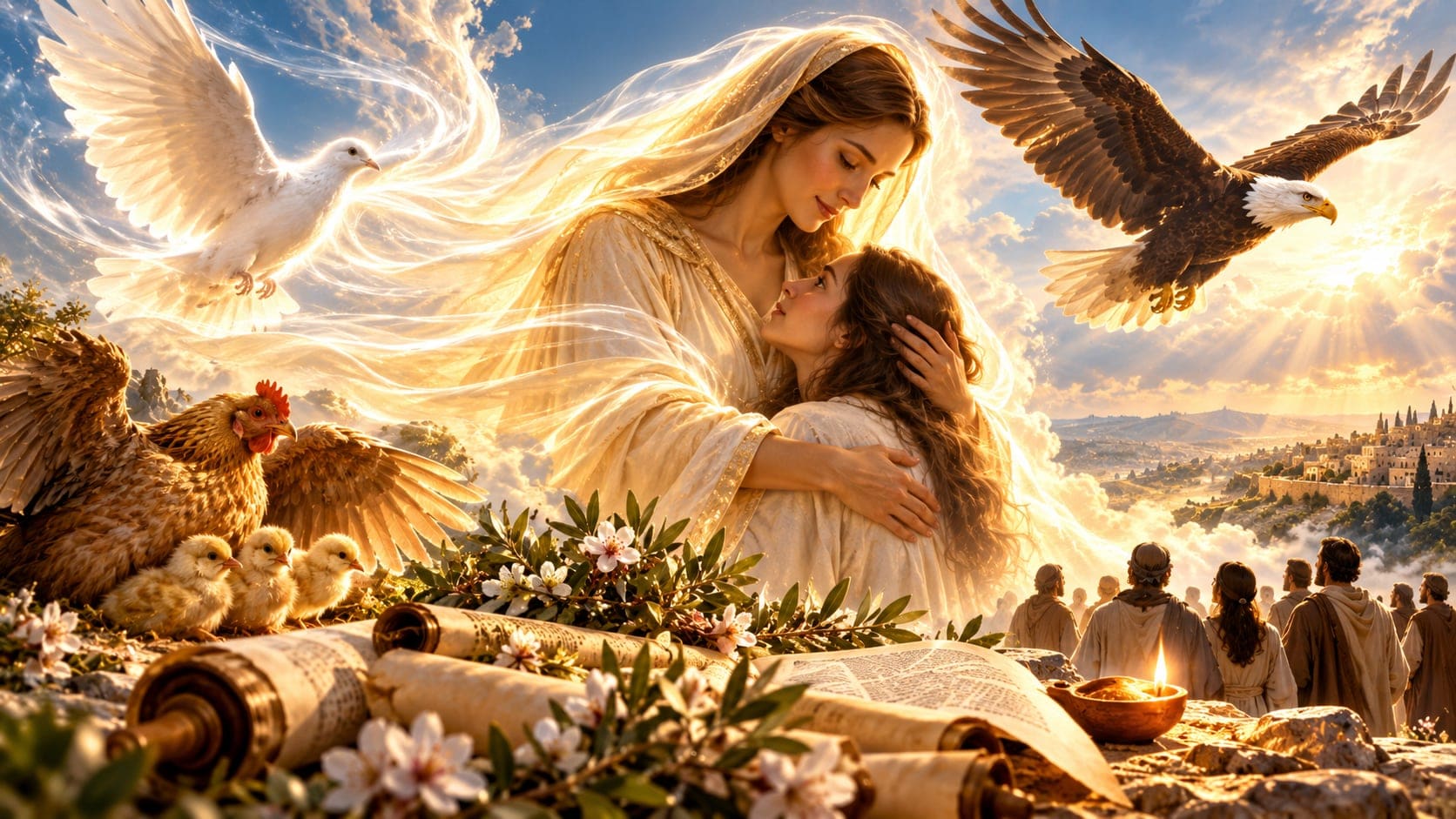
The Holy Spirit is the most mysterious Person of the Trinity, and the Spirit’s nature is often communicated through symbol and allegory. Scripture returns again and again to a family of images — birds who shelter, feed and teach their young.
The anointing dove
All four Gospels record that the Spirit descended upon Jesus at His baptism “like a dove” — Luke adds, “in a bodily shape like a dove” (Luke 3:22). The Hebrew yonah and the Greek peristera are both feminine words, and the earliest dove in the Bible is spoken of as “she”: when Noah sent out the dove, she “found no rest for the sole of her foot, and she returned unto him into the ark” (Genesis 8:9). The dove returned with an olive leaf — a sign of new life after judgment (Genesis 8:11).
In the Song of Solomon the beloved is called “my dove” (Song of Solomon 2:14; 6:9). The dove is gentle, pure and faithful — the form the Spirit chose when anointing the Son.
The sheltering hen
As He looked over Jerusalem, Jesus lamented:
O Jerusalem, Jerusalem… how often would I have gathered thy children together, as a hen doth gather her brood under her wings, and ye would not!
The hen spreads her wings over her chicks in the storm. It is one of the tenderest pictures of God in the Gospels.
The instructing eagle
Moses sang of the LORD’s care for Israel in the wilderness:
As an eagle stirreth up her nest, fluttereth over her young, spreadeth abroad her wings, taketh them, beareth them on her wings: so the LORD alone did lead him, and there was no strange god with him.
A mother who comforts
The images are not only of birds. “As one whom his mother comforteth, so will I comfort you” (Isaiah 66:13). “Can a woman forget her sucking child, that she should not have compassion on the son of her womb? yea, they may forget, yet will I not forget thee” (Isaiah 49:15).
The anointing dove, the sheltering hen, the instructing eagle. Yona Tree reads each as a picture of the Holy Spirit’s care — filling us, protecting us, comforting us, feeding us, and teaching us to fly. And this Mother never abandons Her children:
Whither shall I go from thy spirit? or whither shall I flee from thy presence? If I ascend up into heaven, thou art there: if I make my bed in hell, behold, thou art there. If I take the wings of the morning, and dwell in the uttermost parts of the sea; even there shall thy hand lead me, and thy right hand shall hold me.
The wind
The Spirit is also the wind — ruach in Hebrew, pneuma in Greek. “The wind bloweth where it listeth… so is every one that is born of the Spirit” (John 3:8). At Pentecost “there came a sound from heaven as of a rushing mighty wind” (Acts 2:2). The wind cannot be seen, only its effects — and so it is with the Spirit’s work in a human heart.
The next symbol in Scripture’s gallery is not a bird but a woman — two women, in fact. Their story is told in Jerusalem Above: The Mother of Us All.